Hebrews 12:1-2 (NIV)
Therefore, since we are surrounded by such a great cloud of witnesses, let us throw off everything that hinders and the sin that so easily entangles. And let us run with perseverance the race marked out for us, fixing our eyes on Jesus, the pioneer and perfecter of faith. For the joy set before him he endured the cross, scorning its shame, and sat down at the right hand of the throne of God.
When summer is over, do you always have a story to share? I always have a story to share, even if the summer was a bust and I need to make one up! 😊
Here’s my story from this summer. It began in June with Father’s Day and a birthday. Then July went wild! Family visitors for two weeks, with one of those visits being extra special. My grandson surprised us all when he showed up for a visit. With both visits, we went everywhere. We ate way too much food. We celebrated our country’s 250th birthday on the 4th of July. We laughed till our sides hurt. We talked about days gone by and the people who inspired us. My husband and I celebrated our 50th wedding anniversary. And summer ain’t over yet!
So, what’s your summer story? Or, what’s your story in general? We all have one. Whenever anything happens, be it good or bad, everyone has a story. Stories fill us up. Believe it or not, people enjoy hearing stories. We find ourselves leaning in as the storyteller weaves his story. We want to know more. It’s the “and then what happened” voice every storyteller wants to hear.

Photo by Erik Mclean on Unsplash
Take, for instance, the Johnstown Flood of May 31, 1889. One of the deadliest disasters in American history. The catastrophic loss of life. The failure of the South Fork Dam. The combination of too many events. In other words, the perfect storm. There must be healing after a tragedy like this, right?
How about a Noah joke? Tackey? Humor in the face of immense trauma helps us process overwhelming grief. It makes sense of the suffering. There’s always survivor’s guilt that goes along with tragedy. Then there’s the professional survivor who thinks or speaks of nothing else for the rest of their lives, turning it into a badge of honor. There must be some kind of perspective regarding scale. More importantly, reclaiming control over fear. The victims in this case were entirely helpless against the water. Telling a joke about Noah inverts the power dynamic. It moves the setting from a terrifying floodplain to the safety of heaven. It allows people to control the narrative. It takes a terrifying monster (the flood) and reduces it to a punchline.
Interested in the joke? Of course you are! Keep the scene in Steel Magnolias in your mind when all the friends are at Shelby’s gravesite with M’Lynn. It’s that kind of thing that might not be the right timing or even appropriate, but it worked. They were getting too serious and needed to laugh as Clairee told them.

Image generated by Google AI Nano Banana 2
The Noah Joke
An old man who lived through the 1889 Johnstown Flood finally died of old age and went to heaven. Saint Peter granted him one request. “I want to give a lecture to everyone here about surviving the historic 60-foot wall of water,” the man said. You see, he’d spent his entire life bragging about his survival. Saint Peter agreed and packed the heavenly auditorium the next day. As the proud man stepped up to the microphone, Saint Peter leaned over to him and whispered, “Just remember, Noah is in the audience.”
In the Christian story, in our scripture, we see that each is unique, but there’s a common thread that joins us together. In Chapter 11, it lists the heroes of faith in action. Abel, Enoch, Noah, and Abraham. These people were still living by faith when they died. (vs 13).
In Chapter 12, the author gives us an image of a huge stadium with people cheering on the runners.
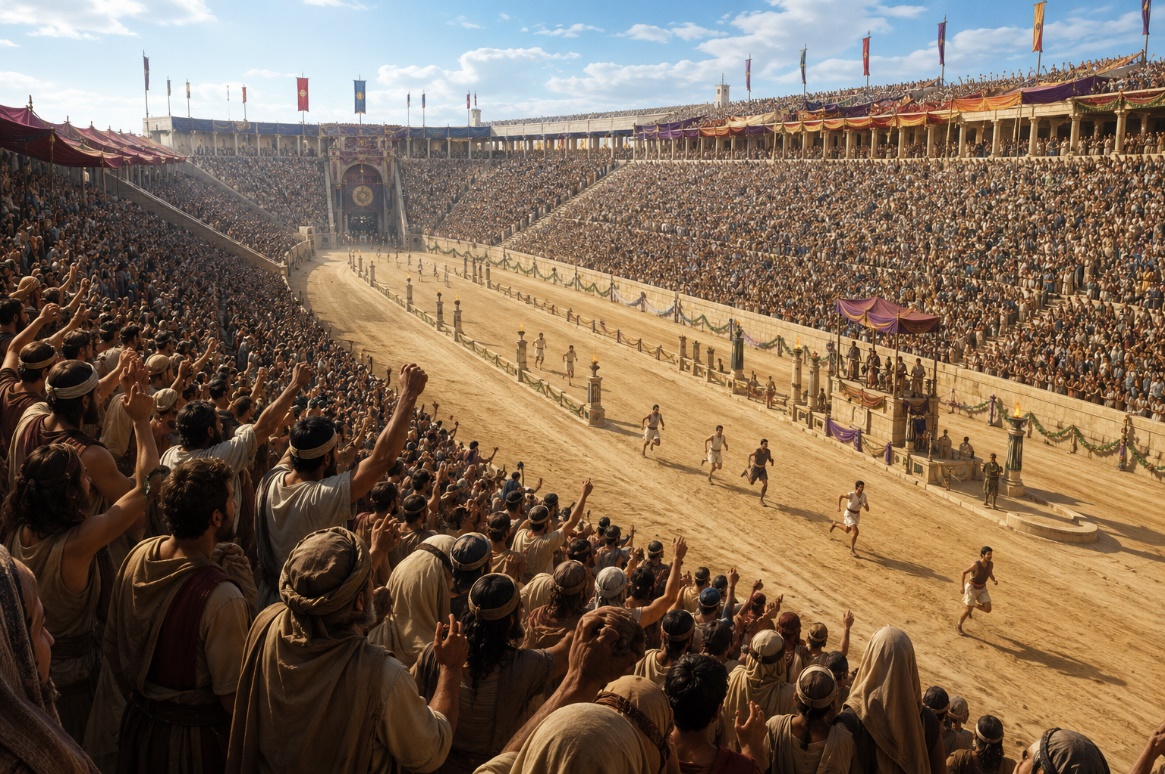
Image created with ChatGPT by OpenAI
Common threads:
- We are surrounded by witnesses. Those are the people who inspire us and encourage us. What’s your story of those who blessed you? My story—Miss Rea, Grandma, Papa, Ms. Fields. Who are your stadium people? My family and friends.
- Some aspect of our story is a weight that’s lifted off us. Do you have a story that shows how a weight was lifted off you? My story is—I carried around a burden of hate for someone who betrayed me. When I finally laid down that hate, I felt such relief in my soul. Hebrews says to lay aside weight. It’s like running with weights and then taking them off. You discover you can fly.
- It’s our race to run. Hebrews lets us run the race set before us. What’s your story about running your own race? My story is—there were circumstances in my past when I had to choose between telling a lie and telling the truth. I knew I had to tell the truth but knew there would be consequences. The race God set before me was whether I would reach for the lie or the truth regardless of the consequences. This meant I had to take a stance. I stood pretty much alone, but I knew I had to stay with that conviction. I had to find my own voice and how to run my own race. We all proclaim our own story. It’s a gift to listen to other stories and to share yours.
- The focal point—Jesus is the hope. He is the resurrection story. He is the essence of what God is all about. Jesus has done for us what we could never do for ourselves.
The final scene.
If Jesus isn’t the focal point of your story, maybe you’re in the wrong book.
Where is your focal point? Money, sex, power, popularity? If you answer “yes” to any of these things, you’re not focused on the right thing. You can’t focus on Jesus when things of this nature are your focal point.
When we strive to look toward Jesus, our love looks different, and our life looks different.
The story of Jesus and His love is the greatest story ever told.
What’s your story? You say you don’t have one?

Photo by Maegan Martin on Unsplash
And that’s what I learned in Church……see ya next time!
